
Planting a Kinder Tomorrow
You start planting a silk tree in Khuzestan Province, which means that you choose to do a meaningful charitable initiative, as your payment for the tree will be completely allocated to the needs of the families supported by Nikan Mammut Charity Foundation.
It is worth mentioning that the buyers receive the geographical coordinates of the tree’s planting location, enabling them to monitor the tree area via Google Earth.
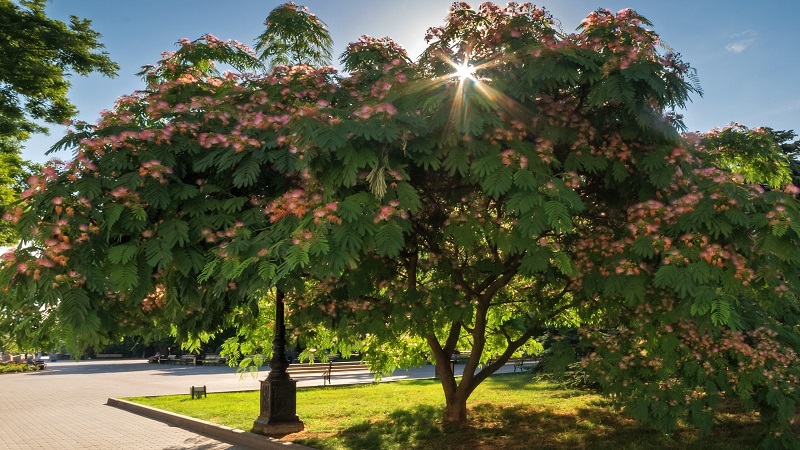
Silk Tree History and Features
The silk tree was introduced to Europe in the 18th century by an Italian nobleman named Filippo degli Albizzi. It is an elegant and umbrella-shaped tree. The silk tree is known for its delicate leaves. They fold in pairs at night, so its common name is the “sleeping tree.”
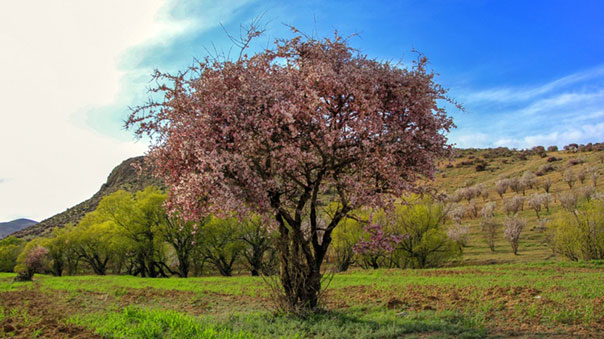
In Iran, this beautiful tree is commonly known as the silk tree. It is widely planted as an ornamental species in home gardens, urban landscapes, and public parks. The Persian silk tree belongs to the legume family and is native to Southwest and East Asia.
The Persian silk tree is a small to medium-sized tree. It typically reaches a height of 5 to 12 meters. It has a broad, spreading crown that provides relatively good shade. The trunk of the Persian silk tree has a silvery-green color. Its leaves are narrow and elongated. They measure approximately 20–25 cm in length, with small leaflets about 2 cm long.
The most effective method for propagating the silk tree is through seed planting and cultivating improved seedlings.
Flowers
- Pink or white
- Appear in clustered, plume-like inflorescences
- Flowering begins in mid-spring, and it continues through the summer
Fruits
- Pod-shaped
- Brown in color
- Hard texture
- Measuring about 10–20 cm in length and 2–2.5 cm in width
- The seeds inside these pods can be used as livestock feed

Climatic Requirements of the Persian Silk Tree
The Silk tree’s climatic requirements have resulted in its natural growth being largely limited to Asia. In Iran, the Hyrcanian (Caspian) forests are the region where silk trees are found more abundantly than elsewhere.
- It is highly tolerant of heat.
- It requires minimal irrigation.
- It can withstand drought conditions well.
- It is suitable for planting in industrial areas, as pollution has little impact on its health.


Users Comment
There are no reviews yet.